Before You Come to the UK: My Honest Advice for New Students
- superadmin | Nov-14-2025
-Bikram Giri
I know many people say that life in the UK is hard — that it’s full of struggles and that finding part-time jobs as a student is almost impossible. And to be honest, there’s some truth to that. But before you worry too much, remember why you’re coming to the UK in the first place — for education, not just to earn money.
Think of your time in the UK as an investment in your future. You might not earn a lot during your studies, but the knowledge, skills, and experiences you gain will open doors later. Once you complete your degree, you’ll have the opportunity to work full-time — and all your hard work and struggle will truly pay off.
When I first arrived, I also found it difficult to get a job. But with patience and persistence, I eventually did. My first job was as a delivery driver for Just Eat, then I worked in a restaurant, and currently, I’m employed at New Cross Hospital (NHS) as a Senior Clinical Support Worker.
If I can make it, then you can too.
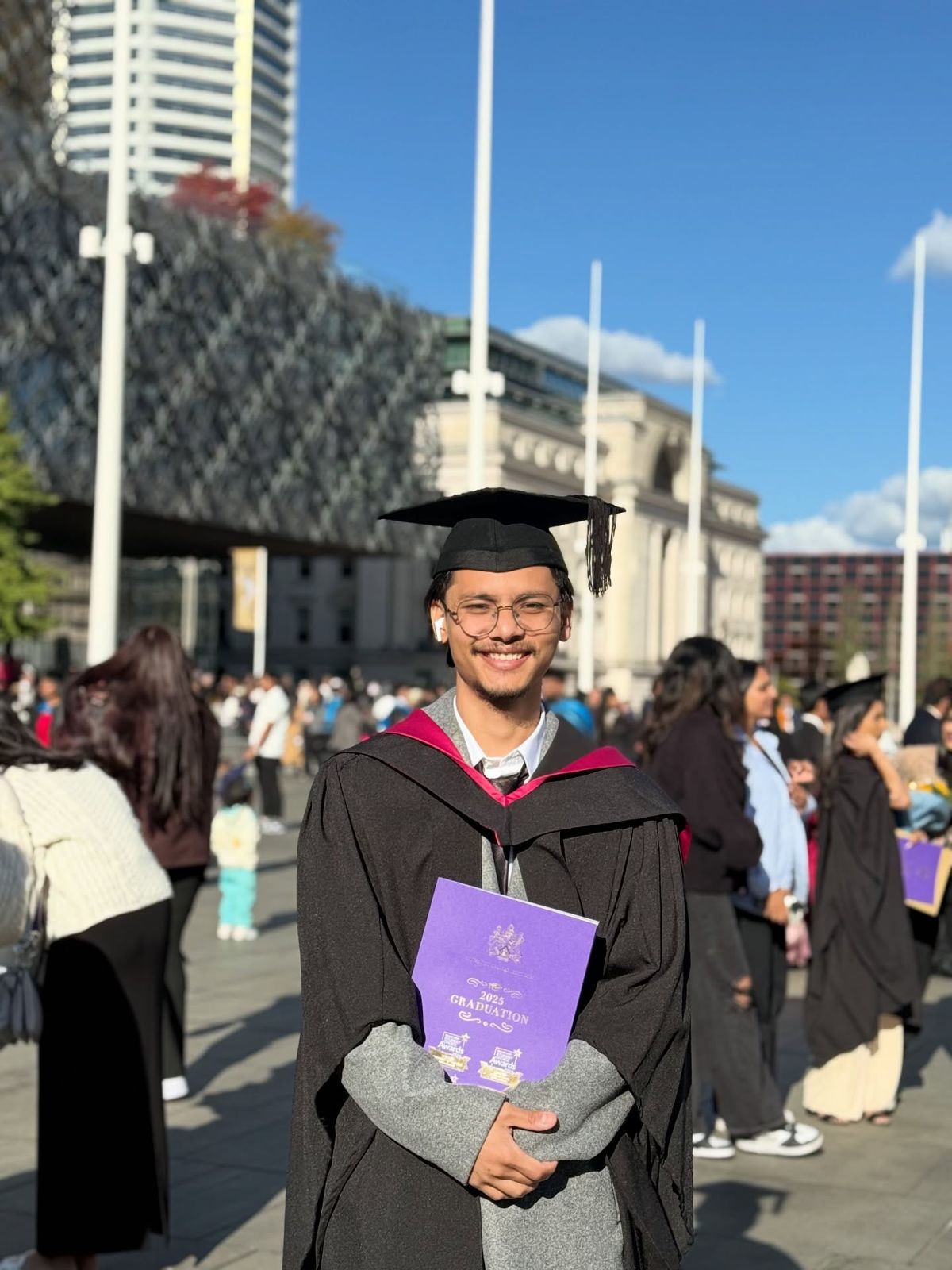
My name is Bikram Giri, and I recently graduated from the University College Birmingham (UCB) with a Bachelor’s degree in Business Enterprise (2025). My journey to the United Kingdom began in 2022, and looking back, it has been one of the most challenging yet rewarding experiences of my life.
Before applying to study in the UK, I was filled with doubt and fear. Questions constantly ran through my mind — “Should I apply? What if I fail? What if I can’t succeed?” The fear of failure was strong, but deep down, I knew I had the potential to make it if I truly tried.
On February 20, 2022, I landed in Birmingham. I was new, nervous, and completely unsure of where to go next. I had no relatives or close friends in the UK, which made finding accommodation extremely difficult in the beginning.
Fortunately, through God’s grace, I connected with a friend on Facebook who kindly helped me find a temporary place to stay. He allowed me to live with him for a couple of weeks until I could arrange my own accommodation. That small act of kindness meant a lot to me at a time when everything felt uncertain.
After a few months, I finally found a more permanent place to live in Wolverhampton. Although it wasn’t very close to my university, it was still manageable—about a 30 to 45-minute journey by bus, train, or tram. I chose Wolverhampton because a few of my friends lived there, and I also found good job opportunities nearby.
For any new students coming to the UK, I would strongly recommend finding accommodation in an area where part-time jobs are available. University classes usually take place two or three days a week, so you’ll spend most of your time where you live. Ideally, choose a place that’s less than an hour away from your campus.
Adapting to life in the UK was not easy at first. The culture, lifestyle, and even the weather were completely different from what I was used to in Nepal. I had no prior experience living abroad, so everything was new and sometimes overwhelming.
During my first year, I struggled with assignments and university coursework. I often doubted myself, thinking, “Maybe I can’t do this.” But with time, patience, and persistence, I learned how to manage everything. Looking back now, I can’t believe how quickly time has passed. Completing my bachelor’s degree from UK, feels like a dream come true.
Many students fear challenges and give up even before trying. But ask yourself — if you were studying in Nepal, would everything be easy there? Of course not. You might have the comfort of your home and your parents’ support, but life still brings its own struggles. Challenges are part of growth, no matter where you are.
There’s no shortcut to success. Every achievement requires effort, patience, and determination. Some students compare the UK with countries like Australia, Canada, or the USA and think life might be easier there. But the truth is, students in those countries face similar challenges. Maybe they have a few advantages here and there, but the reality is the same — you have to work hard wherever you go.
Another common mistake I’ve seen, especially among Nepali students, is comparing their lifestyle with others. Please don’t do that. Everyone’s journey is different. You are the controller of your own life. Focus on your goals and your progress — not on what others are doing or achieving.
If you believe in yourself and your purpose, nothing can stop you.
I also struggled at the beginning, but over time I managed to find my footing. I may not yet be exactly where I want to be, but I’ve completed an important first step — I finished my degree, I found work, and I’m moving forward. That progress matters. I will keep working hard to reach my goals; I will not give up.
The path is rarely smooth. When you are new to a country, everything can feel like a test — navigating transport, understanding assessments, balancing work and study, and learning a new culture. But progress is built from small wins. Each shift, each application, each shift at work, every assignment completed — they all add up. If you are persistent and patient, the momentum will come.
As J.K. Rowling reminded graduates in her famous speech:
“It is impossible to live without failing at something, unless you live so cautiously that you might as well not have lived at all — in which case, you fail by default.” — J.K. Rowling.
That quote captures one of the most important lessons of studying abroad: failure and struggle are part of growth. The fear of making mistakes can keep you from trying, but trying is how you learn, adapt, and ultimately succeed.
It’s also important to keep perspective about outcomes. Yes, while studying you might not earn large sums, and finding a part-time job can sometimes be challenging — but this period should be seen as an investment in your future. National statistics show that the large majority of graduates go on to work or further study within a year or so of graduating. For the 2022/23 cohort, 88% of graduates were in work or further study 15 months after finishing their course, with 59% in full-time employment. These outcomes underline that most students, including international students, do move into employment or continued education relatively soon after graduation. HESA( 88% of 2022/23 graduates in work or further study | HESA)
Specific research into international graduates also shows encouraging results: most international students find jobs soon after graduating and report that their UK study experience has positively supported their career ambitions. This suggests that the quality of education and the skills acquired in the UK play a strong role in opening doors for international graduates. Universities UK (https://www.universitiesuk.ac.uk/sites/default/files/field/downloads/2024-05/Final%20International%20Graduate%20Outcomes%20Report%202024.pdf)
Policy evidence further supports the idea that work opportunities are an important factor in international graduates’ decisions about whether to remain in the UK. For many on the Graduate Route, work opportunities and gaining UK work experience are major reasons they choose to stay and build a career after graduation. If you want to remain in the UK after completing your studies, make use of university career services, local job boards, and networks — they matter. GOV.UK ( Graduate route evaluation - GOV.UK)
Practical tips from my experience: look for accommodation in areas with job opportunities, be open to entry-level roles that build experience, and use every chance to improve your CV and interview skills. Don’t compare your beginning to someone else’s middle. People post highlights, not the daily grind. Your story — with its setbacks and steps forward — is real and valuable.
In short: struggle does not mean failure; it often means you are on the path. Celebrate the steps you’ve taken, keep learning, and keep applying. You’re already moving in the right direction — one hard-earned step at a time.
- More tips.
Choosing the Right Course and University
Before applying to study in the UK, think carefully about your future goals. Ask yourself:
- What do I truly want to do?
- What subjects interest me the most?
- How will this course help me in my career?
Do proper research. Don’t just choose a course because your friends are doing it or because someone else succeeded in that field. What worked for them might not work for you. Follow your own interests and passion.
When it comes to choosing a university, remember that most universities in the UK maintain a similar academic standard. The degree you earn will hold equal value across institutions. What matters more is affordability and how well the program fits your goals.
Lastly, come to the UK with the mindset that your primary focus is education. Once you dedicate yourself to learning and adapting, job opportunities will naturally follow.
Conclusion: Keep Moving Forward With Purpose
Every journey has its own rhythm, its own challenges, and its own victories. When I look back on my time in the UK, I realise something important — success is not a sudden moment, but a long path made up of persistence, courage, and small steps taken consistently. My journey was not perfect, and it wasn’t always smooth. I struggled, I doubted myself, and many times I questioned whether I had made the right decision. But every challenge I faced became a lesson, and every small achievement reminded me that progress is possible when you refuse to give up.
Your journey will be different from mine, but the message remains the same: keep moving forward. Whether you are just planning to come to the UK, have recently arrived, or are halfway through your studies, remember that struggle does not define your future — your response to the struggle does. You do not need to have everything figured out at once. What matters is that you take the next step… and then the next.
Do not compare yourself with others, because everyone’s pace in life is different. Some people succeed quickly; others take time. Some find jobs immediately; others go through dozens of applications. But the measure of success is not how fast you reach your goals — it’s how determined you remain, even when the path feels slow.
The truth is simple: if you keep going, you will improve; if you keep learning, you will grow; and if you keep believing, you will rise. No hardship lasts forever. What feels overwhelming today will one day become the story that motivates someone else.
Remember this — you have already taken a bold step by choosing a new country, a new education system, and a new life. That alone shows courage. The rest will follow with time, patience, and effort. As Nelson Mandela famously said:
“It always seems impossible until it is done.”
Hold that close. Whenever you feel tired, lost, or uncertain, remind yourself that you are building a future worth fighting for. Every assignment you finish, every shift you work, every challenge you overcome is shaping you into a stronger, wiser, and more capable version of yourself.
So, keep going. Don’t stop. Don’t doubt yourself. One day you will look back and realise that every struggle, every sacrifice, and every step — even the difficult ones — led you exactly where you were meant to be.
Your journey is just beginning, and the best chapters are still ahead.

.png)